
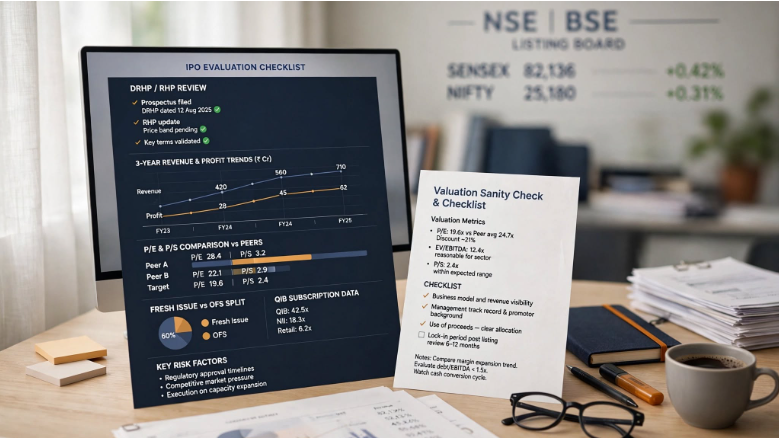
Many people judge an IPO by how much attention it gets. It’s a bit like choosing a busy restaurant just because everyone else is going there. The GMP is up, a few finance accounts on social media are excited, and the application goes in. Nobody has read more than the headline.
An “IPO” is when a company “sells shares” to the public and gets listed on a stock exchange for the first time. It may do this to “raise money” for expansion, “pay off debt” or give early investors a chance to sell their shares. All three are legitimate. They are also very different things to be buying into, and the filing tells you which one you’re dealing with. That’s the reason to read before you apply.
Lot sizes, retail limits and SEBI timelines change, so check the details below against the exchange or SEBI before you act on them.
Tracking upcoming IPOs in India
Each IPO has a few key details, such as opening and closing dates, price band, lot size and issue size. The price band and lot size help you work out how much money you’ll need to apply. Issue size tells you how much demand the market has to find.
The thing to watch is what’s confirmed and what isn’t. Months before an IPO, a company files draft papers, and news sites start printing “expected” dates and “likely” valuations. None of it binds anyone. The price band arrives with the Red Herring Prospectus (RHP), a few working days before the issue opens. Until you see it, anything you’ve read is a guess.
A maintained upcoming IPO list saves you the hassle of piecing this together from five different sites. Use it to see what’s open and what’s coming. Then confirm the final dates and price band against the exchange notice or the RHP before you bid, because that’s the version the company is legally answerable for.
Start with the company’s financial performance
Skip the glossy brand story for a minute and look at the numbers.
The company’s “revenue” and “profit” figures of the past “3” years can tell you more than its latest results alone. Sales may be rising, but falling profit margins could mean it’s offering discounts or spending too much on marketing to bring in customers. Steady growth with improving profit is a better sign, and it’s less common than you’d think.
Then check cash flow from operations. A company may be making a “profit” but still struggle to pay its bills. Maybe customers haven’t paid yet, or too much money is stuck in unsold stock. If profits go up year after year but cash from operations doesn’t, find out what’s going on before investing.
Debt comes next. A heavily borrowed business has little room for a bad year, and if a big part of the IPO money is earmarked to repay that debt, new investors are partly paying to clean up the balance sheet. That’s worth knowing.
Finally, ask a plain question: how does this company make money, and who could take that away? A business that depends on three customers, one supplier or one government policy carries a risk that growth charts won’t show you. Look at the industry too.
How to judge whether the price is reasonable
A “good company” isn’t always worth buying at any price. Many “retail investors” forget to check that before investing.
The “price-to-earnings (P/E)” ratio is the usual starting point. It tells you how many rupees you’re paying for each rupee of annual profit. Take the P/E at the top of the price band and set it beside two or three listed companies doing similar work. Say peers trade around 25 times earnings and the IPO asks for 45. The company would need to grow much faster than those peers to justify the difference. If the prospectus can’t explain why, the premium is probably optimism.
Price-to-sales (P/S) is useful for companies that aren’t making a profit yet, as they have no earnings figure to compare. It’s a rougher tool. A low P/S on a business that loses money on every sale doesn’t mean much, so read it alongside margins. For banks and lenders, price-to-book is the better yardstick, and for capital-heavy businesses, EV/EBITDA.
Be fair to the comparison, too. Peers should be similar in size, business model and growth. Choosing the cheapest listed company to make an IPO look expensive, or the priciest to make it look cheap, is a trick you’ll see in plenty of social media posts.
A famous brand doesn’t change the arithmetic. People love the app, so they assume the shares will do well. Those are two separate questions.
Reading the DRHP and RHP
The “Draft Red Herring Prospectus (DRHP)” is filed with SEBI before the IPO and is open to public comments. The RHP is the near-final version that comes out just before the issue opens, and it includes the price band. They run to hundreds of pages. Nobody expects you to read every line. These parts are worth your time:
Risk factors first. Ignore the generic ones that appear in every prospectus. The specific ones are the gold: customer concentration, pending cases against promoters, dependence on a licence.
Then “objects of the issue,” which says where the money goes. New plants, technology or acquisitions are a bet on growth. Repaying debt is housekeeping. “General corporate purposes” tells you almost nothing.
Then the financial statements, including restated numbers, auditor remarks and contingent liabilities. Finally the shareholding before and after the issue.
Look closely at the split between fresh issue and offer for sale (OFS). In a fresh issue, the company creates new shares and keeps the money. In an OFS, existing shareholders sell and the company gets nothing. An issue that’s mostly OFS means early investors or promoters are taking money out. That’s not automatically bad, since funds have to exit eventually, but you should know why they’re selling now.
IPO GMP and what the market is signalling
The “grey market premium (GMP)” is the unofficial price at which IPO shares change hands before listing, compared with the issue price. If the issue price is ₹100 and the GMP is ₹30, traders are hinting at a listing near ₹130.
I’d treat it as gossip with a number attached. The grey market is unregulated, a small group of traders can move it, and it can swing within hours. It tells you how some people feel today. It tells you nothing about whether the business is sound.
Subscription status is more useful, because the exchanges publish it live, by category: qualified institutional buyers (QIBs), non-institutional investors (NIIs) and retail. Strong QIB interest suggests large funds did their own homework and liked the answer. A retail category subscribed 40 times while institutions stay quiet should make you stop and think.
Neither signal guarantees a listing gain. Many heavily “oversubscribed IPOs” have listed flat or dropped below issue price within weeks. Listing-day mood and the price you paid count for as much as demand during the issue.
Risks worth taking seriously
Overvaluation is the first. Companies usually prefer to launch their IPOs when the market is doing well. You could end up paying a high price, especially near a market peak. Even a good company can list when the market is falling, and there’s little anyone can do about that.
Weak financials are a risk that people wave away when the story is exciting: shrinking margins, rising debt, losses that keep widening. Hype tends to paper over these in the first week and stop covering for them after that.
Governance matters more than most retail investors give it credit for. Check how much the promoters will hold after listing, whether any shares are pledged and whether there’s regulatory action in the background. Bad governance seldom wrecks the story at launch, but it has a way of showing up in the share price later.
Then there’s the plainest risk of all, which is applying only because everyone else is. Your money is also blocked until allotment is settled, and any shares you receive may have to be held through a dip. Cash you need for rent, EMIs, fees or emergencies doesn’t belong in an IPO. And don’t put a large share of your savings into one or two issues.
A checklist before you apply
- First of all, start by confirming “dates”, “price band” and “lot size” from the exchange notice or RHP, not a forwarded message.
- After that read the risk factors, objects of the issue and restated financials.
- Compare “P/E”, or “P/S” for loss-making companies, with similar listed peers.
- Check the fresh issue and OFS split, plus the debt position.
- Watch subscription data by category as it comes in.
- Decide how you’d feel if the stock fell 20 percent after listing, and whether you’d need to sell.
- Settle in advance whether you want a listing gain or a long-term holding. Mixing those two plans up is a common way to get hurt.
Frequently asked questions
Is every upcoming IPO in India worth applying for?
No. Each issue has a different business, price and risk. Applying to everything isn’t a strategy.
What is the difference between DRHP and RHP?
The DRHP is the draft filed with SEBI for review and public comment. The RHP is the near-final version issued before the issue opens, and it carries the price band.
Does a high GMP guarantee listing gains?
No. GMP is unofficial and can fall sharply before listing day.
Where can I check official IPO details?
The RHP on the SEBI, NSE and BSE websites and on lead managers’ pages, plus exchange notices for live subscription figures.
Final thoughts
Overall, an “IPO” launch is designed to grab your attention, and a lot of the noise around it is built to do the same. You should slow down and read the filing, check the “price” against similar companies and decide how much of a loss you could live with. If the numbers hold up, apply calmly. If the story is better than the financials, skip it. There’s almost always another issue coming within a couple of weeks.
This article is for general information and isn’t investment advice. Consider speaking to a SEBI-registered advisor before investing.
